Tag: ethics

On curiosity, the pedagogy of the question and not being good

In the midst of preparing my learning exercise on women’s studies, curiosity and the pink sneaker, I came across an interview with Paulo Freire entitled “The Future of School.” Check out what he has to say about curiosity, the pedagogy of the question and not being a good boy:

I am the antagonist of pedagogy. I am the antagonist of epistemology. I am the opposite ethic. I am nothing of that, because I am the antagonist of that. And I insist, I don’t like discourses. I am not a “good boy.” I try to be a good person, but “good boy” — God forbid! If you want to hurt me, call me a “good boy.”

I am an educated person, very educated, polite, disciplined, and courteous. That I am, indeed, and more. I try to be respectful, but “good boy,” for God’s sake, no! So I am antagonistic to all this. I am contrary, the opposite of all this. I believe in the pedagogy of curiosity. That’s why I defend, along with the Chilean philosopher Fagundes, the pedagogy of the question and not of the answer. The pedagogy of the question is the one that is based on curiosity. Without that pedagogy there would not be a pedagogy that augments that curiosity.

After reading this brief excerpt from the interview, I was curious: what is the pedagogy of the question? The idea of asking lots of questions is central for my own pedagogical practices, particularly in my feminist debates class; the final part of this entry exemplifies this approach. I became even more curious when I found Freire’s book, Learning to Question. Now I just need time to read it and think about it in relation to my own practices and ideas about the question/questions. Maybe I will even assign part or all of this book to my students next fall in my Feminist Pedagogies course?

Another part of Freire’s brief remarks intrigued me as well: the deliberate way he distinguishes between the “good person” and the “good boy”.  Here the good boy seems to be a direct reference to the good student who always obeys the teacher, complies with their demands and passively absorbs information without questioning or challenging it. For Freire, not being a good boy does not suggest that one is a bad person, that is rude or disrespectful (a disciplinary problem, perhaps?). Now, what is Freire doing with this statement? Is it merely a move to prove his respectability as a teacher, scholar, person–see, just because I ask questions doesn’t mean I am a bad person, a delinquent!?  Or, could he be doing something more here (or maybe could we do something more here) with this distinction? In opposing the “good boy” with the good person, Freire could be suggesting that in order to be a good person, one must necessarily question and be curious; one must not be a good boy. So, to be a good boy is to not be a good person? Hmm…I need to think about this some more.

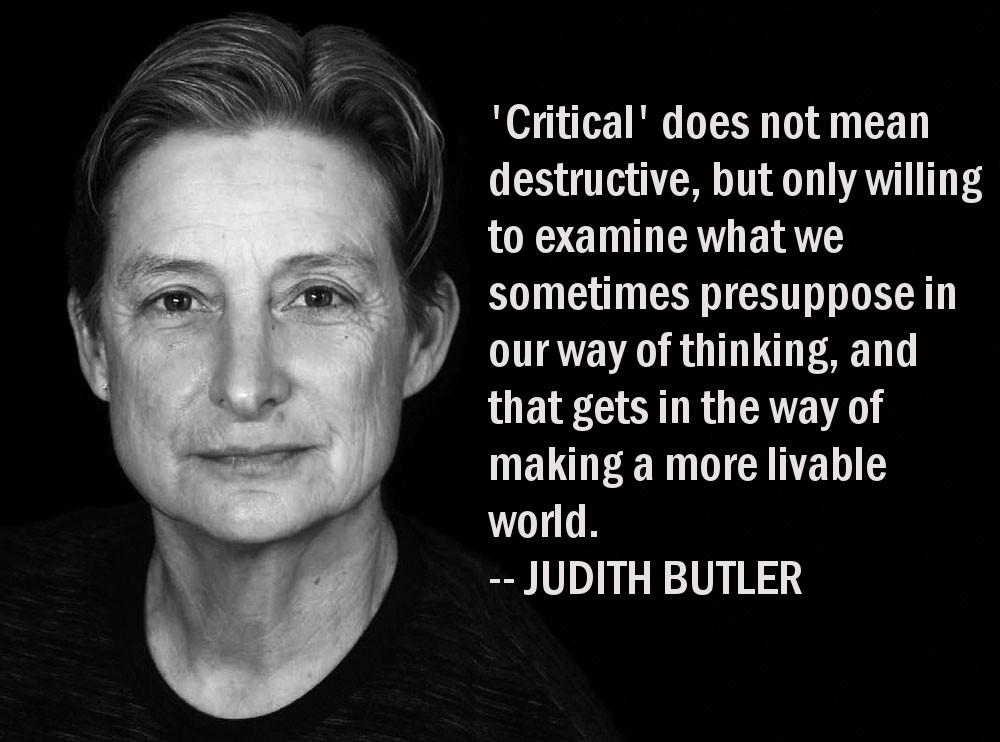
Note: I think it is significant that he describes it as not being a good boy (as opposed to being a bad boy). This sounds a lot like my discussion of Foucault’s notion of not being governed in certain ways or my discussion of Butler’s idea of asking why as a form of not-obeying. Excellent. What connections can I draw here?

  • Del.icio.us
  • Digg
  • Facebook
  • Google Bookmark
  • StumbleUpon
  • Technorati

Linking care with troublemaking, part 2: What does it mean to care?

This entry is part of my series on care and its connections with troublemaking. As I mentioned previously (here and here), I am interested in thinking through what care is and how it does/doesn’t connect with troublemaking. So, what does it mean to care? Having just written a brain-melting chewy bagel about Foucault, Butler and virtue ethics, I want to keep this entry a little lighter–maybe light like a double-glazed donut…umm, double-glazed.

Anyway, this morning my son FWA, who is 2 weeks away from turning 7, read his weekly “watch me read” book to me (thanks, FWA for waiting until this morning to remind me about this assignment–just 30 minutes before you had to leave for school!). This week’s book, which is part of Houghton Mifflin’s Invitations to Literacy Series, was “We Care.” As you might imagine–that is, if you are a regular reader here–the title made me curious. What do they mean by care? And, who is the we that cares?

So, the story is about a little girl who passes by a local homeless shelter called Main Street on the way to school everyday. One day she decides to ask her teacher about the shelter and whether or not the people who go there have beds and enough food. In other words, she is curious and cares about these people and their needs. The teacher doesn’t know but decides that being curious about Main Street might be a good project for the whole class so she encourages them to  curious about the residents of Main Street. But, the teacher doesn’t just want her students to be curious, she wants them to do something with that curiosity. She organizes the students and their parents into a plan of action: they will give care to the residents of Main Street by bringing food and other things the residents might need and by performing a play. A big chunk of the story (which is 16 pages total) is devoted to describing how the students, their parents, and the teacher all get involved in preparing the gift boxes and the play. Towards the end of the story, the class goes to the shelter and delivers their boxes to the head of Main Street and performs the play for the residents. The experience gives the students such a “warm feeling” that they decide they want to do more. The teacher suggests that they tell other classes about the shelter project so that those classes can care about and care for too. Here is how the story ends:

Now our school often brings food and other things to Main Street House. We don’t put on a show every time we go, though. But that’s all right. Our class trips show we care (16).

So, “we care” means:

  • to be curious about others
  • to care about those others and their needs
  • to do something for those one cares about by giving care to them
  • to spread the word to others
  • to engage collectively in caring about and caring for

There are many things that I like about this story. I like that kids are being encouraged to care. I like that caring about isn’t enough and that action, in the form of giving care, is also required. I like that that care is imagined as collective and involving more than an individual; it includes the class, the entire school, and even the larger community (including parents). I like that continued and repeated caring is necessary–students shouldn’t just care once, they need to care again and again by visiting Main Street House repeatedly.

But (you knew it was coming, right?), I was also troubled by this story because it left out some crucial steps and some very important actors in the process. First, the students are never encouraged to collectively develop or critically reflect on how or why they should care about these residents. The process of figuring out what form of care might be most effective for the residents is never discussed. Moreover, the reasons why the residents are homeless are never addressed (or even asked). The student, Jynelle, doesn’t ask why some people are living at Main Street instead of in their own homes; she merely asks if they have enough beds there. I don’t know how much time you have spent around little kids, but the first question that they are often compelled (and it does almost seem like a compulsion) to ask is: Why? Athough maybe by the time students are in 3rd grade, they have already been conditioned out of asking why–scary thought. In the context of this story, not asking why is significant. Asking why indicates that the way something appears to be should not just be assumed to be the way it should be or the way that it always has been (In another entry, I discuss the importance of why for critical thinking and troublemaking). When the student doesn’t ask why, it is implied that why doesn’t matter because homeless shelters are just the way the world works: some people are homeless, some aren’t. It’s a fact of life. Don’t try to change it, because you can’t. For me, the failure to ask why is a major problem. Asking why isn’t just about trying to make trouble by creating extra work for the teacher or by distracting us from the real work of developing solutions or plans of action for caring about those people. To ask why is to claim that the situation of being homeless is not to be assumed and that it is something that could and should be different. It is the first step in challenging and resisting injustice. And it is the first step in transforming yourself into a person-who-doesn’t-merely-accept. Uh-oh, didn’t I just talk about this in my last entry? This entry is in danger of becoming another chewy bagel. Let’s just say, asking why is important.

A second problem: Something big is missing in this story: the actual people who are receiving the care, the residents of Main Street Shelter. We never get to read about the actual stories of these people. And they aren’t visually represented in the text. When the story describes the students’ play at Main Street, the illustrations are of the children performing. We also never get to read about their reactions to the care that they are given. When the story describes the effects of the Main Street project, there is no discussion of how it benefits the residents or how the care makes a difference in their lives. Instead, the story focuses on how giving care to the residents gave the students warm feelings.  This is a problem because giving effective care necessarily requires that we ask about how we should give care. We shouldn’t assume (or presume) to know what needs should be addressed. We need to ask those to whom we are giving care,  How can we help you? Or, even better, how can we make it possible for you to help yourselves? This is also a problem because, by leaving the actual voices and experiences of those who need care out of the story, those who receive care are reduced to objects (as opposed to subjects) of care.

Since this entry is getting too long (I didn’t realize that I would have so much to write about this book), I need to stop. But, before I do, I want to offer some practical ways to tell this story differently–practical ways that might be even approved for use in an elementary school…well, as long as it isn’t in Texas. So, here are my suggestions for some small (but potentially transformative) ways to make this a story that offers a more expansive and effective vision of what it means to care:

  • Have the teacher contact the shelter and actually ask: what can we do to help? What care can we give to your residents? You could have her ask the director or, even better, have her talk with actual residents.
  • What about including a brief mention (even a sentence would help) of how a resident or the director visited the class and told them about the shelter and what the residents needed.
  • Let Jynelle ask why. You don’t even have to answer it (although that would be awesome), just let her ask it.
  • Include some faces, names, voices of the residents. At least include them in some of the pictures.

Okay, here is one suggestion that might be too ambitious for a third-grade level book:

  • Instead of talking so much about how students get a warm feeling because they feel good about caring for others, focus just a little more attention on why they are sad (at least you mention it on page 13) or even why they are mad that others don’t have a home.

Okay, my brain (and the rest of me too) is done. Now I want to find some kids’ books that talk about social justice and encourage kids to question and challenge. Any suggestions?

  • Del.icio.us
  • Digg
  • Facebook
  • Google Bookmark
  • StumbleUpon
  • Technorati

My 100th Post or the Winner of the Chewy Bagel Award for 2010

It is hard to believe, but this is my 100th post. Way back in July, I wrote my 50th post. Sure, it has taken me a while to double that number, but I am still very proud of how much I have written in this blog. In the 50th post I mentioned how I had written a total of 36,301 words. Here is the word count now: 79, 418! Why does this matter? I am not totally sure…maybe it just sounds more impressive to say such a big number (am I admitting too much?)

What, you may ask, is the “chewy bagel award”? Many years ago my dad read my presentation on Judith Butler, radical democracy and identity politics that I wrote for the National Women’s Studies Association Conference. After finishing it, he remarked on how dense it was and what careful attention and concentration it demanded of the reader. On the top of the presentation he wrote, “Winner of the Chewy Bagel Award for 2004.” I think that this 100th post, which is all about Foucault, critique, Butler and virtue is worthy of the “Chewy Bagel Award for 2010″ for 2 reasons. First, this post is a chewy bagel because it is dense and requires that both the writer (me) and the reader (you) devote substantial time to thinking through the claims that Foucault, Butler and I are making about critique, disobedience, troublemaking and virtue. Second, this post is a chewy bagel because it is about promoting slow and careful rumination (chewing) on ideas, words, and claims. Here is what Butler says in “What is Critique: An Essay on Foucault’s Virtue” about the need for chewiness and how it enables us to patiently and persistently think and reflect:

But here I would ask for your patience since it turns out that critique is a practice that requires a certain amount of patience in the same way that reading, according to Nietzsche, required that we act a bit more like cows than humans and learn the art of slow rumination (307).

A dense, chewy bagel cannot easily be consumed. It requires effort to be eaten. A chewy bagel text is the same way. It is not meant to be easily understood or digested. It demands that we devote some serious time and effort to engaging and processing the ideas that it presents. I love the idea of cultivating patience and persistence; it resonates with one of my own visions of troublemaking, which I wrote about way back in May.

Okay, enough build up to this 100th post. Here it is. Enjoy, or should I say, bon appetit!

A couple of days ago I wrote about how I had found a way to frame the second part of my essay on Butler, troublemaking and virtue. I plan to do a close reading of her essay, “What is Critique? An Essay on Foucault’s Virtue?” In coming up with this approach, I was particularly inspired by Butler’s aside at the end of the essay. She writes:

…I do not mean to rehabilitate Aristotle in the form of Foucault (although, I confess, that such a move intrigues me, and I mention it here to offer it as a possibility without committing myself to it at once (319).

Yes! While I am also not interested in rehabilitating Aristotle through Foucault or Butler (what would it mean to rehabilitate anyway–to return or restore?), I do see a lot of potential in thinking about troublemaking (in Butler and beyond) in relation to virtue ethics and Aristotle’s Nicomachean Ethics. Discussions of character/attitude, flourishing, the need for role models, and self-making are important for my own development of the moral significance of making and staying in trouble. I want to use this entry to work through some of the connections between Foucault, Butler, troublemaking and virtue.

So, what is the connection between Foucault and virtue? Here is an answer that I gave a few months back:

My vision of troublemaking as an ethical attitude is partly inspired by Michel Foucault and his discussion of the limit attitude in “What is Enlightenment?.” He describes this attitude, which he also calls the “critical ontology of ourselves” as “an attitude, an ethos, a philosophical life in which the critique of what we are is at one and the same time the historical analysis of the limits imposed on us and an experiment with the possibility of going beyond them” (319).

In his discussion of the critical attitude (or critique), Foucault uses the language of virtue ethics. His emphasis on attitude/ethos/philosophical life is about the quality of one’s character and how we should live and approach our actions. While my own thinking about virtue and Foucault is based on “What is Enlightenment,”  virtue-speak is also very present in “What is Critique?” (a lecture from 1978 that predates his more well-known, “What is Enlightenment?”). Consider what Foucault writes about critique/critical attitude as

a certain way of thinking, speaking, and acting, a certain relationship to what exists, to what one knows, to what one does, a relationship to society, to culture and also a relationship to others (24).

And how he explicitly connects it to virtue:

There is something in critique which is akin to virtue. And in a certain way, what I wanted to speak to you about is this critical attitude as virtue in general (25).

Hmm…note how Foucault doesn’t say that the critical attitude is a virtue, but virtue in general. What does that mean? How are critique and virtue connected here? I hope to revisit this claim later. After contrasting some ways in which critique is often understood (as a judgment, way of evaluating ideas or norms, centered on fault-finding, distanced from actual practices) with how Foucault envisions it (as the suspending of judgment, only realized in concrete situations and practices, aimed at exposing the very framework of evaluating good/bad, right/wrong, productive/unproductive), Butler takes up the claim that the critical attitude is (a) virtue on page 308 (in The Judith Butler Reader). She ruminates on what Foucault means by virtue, writing:

  • virtue is about an attribute or a practice of a subject OR a quality that conditions and characterizes a certain kind of action or practice (308)
  • It is not only a way of complying with/conforming to norms, but a critical relation to those norms (309)
  • Foucault envisions this as a stylization of morality [stylization = fashioning = self-making]

This critical relation to the norms is about not fully complying with those norms and about questioning their validity and their limits. This questioning is not meant to merely refuse or resist a norm–in the case of this essay, Foucault positions his argument in relation to the norms of governmentality/what it means to be governed, or “how not to be governed” (312). Instead, a critical relation to the norm (to being governed) is to ask after why one is governed in such a way and “how not to be governed like that, by that, in the name of those principles, with such and such an objective in mind and by means of such procedures, not like that, not for that, not by them” (Butler, 312). For Butler, raising these questions goes beyond calling out a form of being governed as invalid; it marks the limits of how governing is established and calls into question “the epistemological orderings that have established rules of governmental validity” (313).  In other words, to question a rule/the rules of governmentality is to do more than find fault with that particular rule (a “traditional” role of critique); it is to question and expose how governmentality has been ordered in a particular historical/cultural moment. And it is to open up a space for critically exploring how the system of rules is ordered and how that ordering shapes who/what is governed and how. Butler writes:

To be governed is not only to have a form imposed upon one’s existence, but to be given the terms within which existence will and will not be possible (314).

Wow–this language sounds strikingly familiar to the discussion of the livable life and which lives are possible that she makes in Undoing Gender, which was written 4 years after this essay on Foucault and critique. Interestingly enough, in her more recent work (from Undoing Gender in 2004 and on), the work that is labeled as her “turn to ethics,” she doesn’t explicitly invoke Aristotle or virtue ethics. What happened? She still uses virtue ethics language, like “flourishing” or “the good/livable life,” but never theorizes them in relation to Aristotle or Aristotle through Foucault. More on that later. For now, let’s focus on Foucault and virtue as a critical relation to norms.

A critical relation to norms is not just a rejection of or a judgment against those norms. Throughout his work, Foucault discusses a number of reasons why he isn’t interested in rejection or judgment:

  1. Foucault doesn’t think that one can ever fully reject and be free of norms because it is through those norms that we come to exist (and be produced) as subjects; to reject those norms is to reject ourselves (which is not possible).
  2. He dislikes how judgment usually takes the form of polemics that discourage thought and prevent engagement with ideas and with each other.
  3. Finally, he is not interested in determining what is good or bad because that type of judgment shuts down action. He writes:

    My point is not that everything is bad, but that everything is dangerous, which is not exactly the same as bad. If everything is dangerous, then we always have something to do. So my position leads not to apathy but to a hyper- and pessimistic activism (256, Foucault Ethics: Volume I).

So, instead of rejection or judgment, a critical relation to norms is about something else. It is about virtue as “a non-prescriptive form of inquiry” (308) that is not based on rules or on training one’s character to properly submit to rules. Foucault’s idea of virtue is about the “the art of not being governed, or, better, the art of not being governed like that and at that cost” (312). Foucault and Butler want to distance their version of virtue from obedience to rules and the idea that virtue/virtue ethics is the training of one’s character so that it properly (and effortlessly) conforms to the standard/norm of what is “good” or what leads to happiness (eudamonia). Instead, they envision the practice of virtue to be concerned with the transformation of the self into a person who not only questions the rules, but who questions their own relation to the rules and who asks: a. how have I been produced in relation to those rules? b. how do these rules determine whether my life is possible or not? and c. how might I live otherwise in relation to these rules?  Here’s how Butler asks these questions:

What counts as a person? What counts as a coherent gender? What qualifies as a citizen? Whose world is legitimated as real? Who can I become in such a world where the meanings and limits of the subject are set out in advance for me? By what norms am I constrained as I begin to ask what I may become? And what happens when I begin to become that for which there is no place within the given regime of truth (314-315)

I am again struck by the close parallels between Butler’s language in this essay and her language in Undoing Gender. Undoing Gender still shows traces of virtue-speak, but there is not explicit connection made between the above questions and Foucault’s virtue. Why not?

Again, I hope to take the point about Butler and the shift from this essay on Foucault to Undoing Gender and other ethical texts (Precarious Life, Giving an Account of Oneself)  later in my larger project on Butler and her “ethical turn.” For now, I want to get back to the crucial connection between a critical relation to norms (as not obeying, questioning) and virtue. The key here (and the key, I think, for my own thinking about why troublemaking is a virtue and why virtue ethics are important for envisioning projects like Butler as ethical projects) is that a critical relation to norms or being critical of authority necessarily demands the transformation of the self into one-who-doesn’t obey or one-who-questions. Butler writes: “To be critical of an authority that poses as absolute requires a critical practice that has self-transformation at its core” (311). Transforming one’s self into one who questions or who refuses to accept authority as absolute requires training that self through repeated practice (habit) of questioning and interrogation of the limits of that authority. Butler describes this repeated practice in terms of Foucault and his idea of “the art of voluntary insubordination” or the styling of the self, through the cultivation of a particular set of practices, into someone who resists and thinks otherwise. I wonder: what connections can we draw between Aristotle’s habitual practice of virtue and Butler’s notion of performativity/citationality?

Now, this sounds a lot like virtue and the forming of a virtuous self through the repeated practice of virtuous acts. Is it the same? While I don’t have a space to (this entry is already ridiculously long at 2230 words and I am not interested in making it a ridiculously ridiculously long entry) or the interest in (maybe in a future essay) outlining how virtue and habit work in Aristotle, I want to briefly mention one way that Butler (and presumably Foucault) wishes to distinguish the art of insubordination with Aristotelean habit: Foucault’s stylization of the self is not done by an autonomous self who can easily or fully reject authority or whose ability to resist can be derived from an autonomous will or some inner essence that is free of the power that she resists. The person who transforms themselves into one who resists/who questions/who doesn’t accept authority as absolute risks a lot in doing so. What do I mean by this? I confess that my patience (and I fear, yours) has run out. Chewing on an idea is great, but at a certain point your jaw gets tired–Am I taking this metaphor too far? I think I need to wrap this entry up. Before I do, here are two passages from JB that speak to my last point that I want to address in a future entry…or two…or three…or more:

In deliberating on what Foucault is suggesting about the self and their agency and intentionality in their actions, Butler writes:

Although Foucault refers quite straightforwardly to intention and deliberation in this text, he also lets us know how difficult it will be to understand this self-stylization in terms of any received understanding of intention and deliberation (321).

In concluding her essay on Foucault, Butler writes:

The self forms itself, but it forms itself within a set of formative practices that are characterized as modes of subjectivations. That the range of possible forms is delimited in advance by such modes of subjectivation does not mean that the self fails to form itself, but to form itself within forms that are already more or less in operation and underway. Or, one might say, it is compelled to form itself within practices that are more or less in place. But if that self-forming is done in disobedience to the principles by which one is formed, then virtue becomes the practice by which the self forms itself in desubjugation, which is to say that it risks its deformation as a subject, occupying that ontologically insecure position which poses the question anew: who will be a subject here, and what will count as a life, a moment of ethical questioning which requires that we break the habits of judgment in favor of a riskier practice that seeks to yield artistry from constraint (321).

Wow, I could write a whole ridiculously long entry unpacking this final statement. I love the last line about breaking habits. How might troublemaking as virtue be about breaking old habits (or breaking from habits) and forming/training new ones? What does a virtue ethics that emphasizes being un-trained instead of just being trained? Cool–now I just need another week of spring break to explore these questions. Sigh…

Word Count: 2680

  • Del.icio.us
  • Digg
  • Facebook
  • Google Bookmark
  • StumbleUpon
  • Technorati

Judith Butler and Virtue: the starting point

Currently I am working on an essay in which I reflect on the ethical significance of J Butler’s cultivation and promotion of troublemaking. The first half of the essay, which I prepared for the FEAST conference last fall, focuses on the ethical gesture towards troublemaking that Butler makes in Gender Trouble. The second half of the essay focuses on linking that ethical gesture to virtue ethics and on developing my own claim that staying in trouble is an important virtue.

I haven’t fully developed the second half of the essay, partly because I haven’t had the time and partly because I haven’t had the inspiration. Sure I want to argue that troublemaking is a virtue, but how? And why virtue? While vague and unfocused answers to these questions have been swimming around in my brain for a few years now, the specific way to articulate my argument in relation to Butler and virtue ethics has eluded me.  But a few weeks ago, I began to envision an approach. Butler’s work over the past decade is filled with vague references to virtue ethics–she often refers to flourishing and the good life and links them with her ideas of persisting and the livable life (which are central to many of her recent works, including Undoing Gender, Precarious Life, Frames of War). She focuses some attention on Aristotle, particularly in her edited collection with Laclau and Zizek, Contingency, Hegemony and Universality. And she even devotes an entire essay to Foucault, virtue and critique (“What is Critique?” An Essay on Foucault’s Virtue“). I realized that one way to frame my discussion of Butler, troublemaking and virtue is to ask: why does she refer to virtue and draw upon virtue language frequently?

After pondering these questions for a few weeks I decided that I needed to carefully reread “What is Critique?” and think about how Foucault and, by extension, Butler are thinking about virtue. So, I reread it tonight. Cool. Very, very helpful. Since I plan to give the whole essay a lot more attention in the next few days (especially during my writing date with KCF!), I won’t write much now. Let me simply offer a teaser. Towards the end of the essay, after discussing how Foucault understands virtue as: a. a critical relation to norms, b. a way of re-describing resistance (outside of the autonomous self), and c. a self-making through the refusal to obey (that sounds familiar–didn’t I write about that idea here?), Butler offers this very brief aside:

I do not mean to rehabilitate Aristotle in the form of Foucault (although, I confess, that such a move intrigues me, and I mention it here to offer it as a possibility without committing myself to it at once) (319).

What do we make of this aside? Is she suggesting that troublemaking (in the form of critique–because she never uses the word trouble in this essay) is a virtue? Is she also suggesting that we might want to think some more about the usefulness of Aristotle’s work, particularly in terms of virtue/virtue ethics? Excellent. What would it mean to re-think Aristotle through Foucault and to imagine virtue in terms of trouble and critique? Does reading Aristotle through Foucault suggest a resignifying of virtue (that is, an inhabiting of virtues and virtue language differently)? Am I a nerd because I find this discovery of Butler’s aside to be truly exciting (or because I made a reference to Bill and Ted’s Excellent Adventure)?

  • Del.icio.us
  • Digg
  • Facebook
  • Google Bookmark
  • StumbleUpon
  • Technorati

Does troubling virtue = valuing vice? And other questions about vice and virtue, part 1

Note: Having just finished this entry after almost 4 days of deliberating over how to frame it and what to write, I feel compelled to comment on my blogging process. I am not sure if this entry makes sense, but it has been incredibly productive for me as I attempt to place my own thinking about virtue ethics and troublemaking in a larger context. Writing this entry has enabled me to clarify my thinking, generated a lot of new questions and sources, and has fueled my passion for troubling virtue ethics. Cool. This entry is one reason why I love blog writing.

Way back at the end of May, I wrote a rather lengthy entry about Peter Sagal’s book, The Book of Vices. I had a big problem with a key passage in his introduction:

In the long war between Vice and Virtue, Virtue has been met on the battlefield, routed, defeated in detail, occupied, and reeducated in prison camps. When last seen, Virtue was working on the Strip in Las Vegas, handing out color flyers advertising in-room exotic dancers. She says she’s happy, but she doesn’t meet your eyes (2).

I don’t want to rehash my argument in this entry. Instead, I want to take up the question of what happens to virtue when we trouble it (queer it? displace it? pose problems to it? jam its codes? rework it)? Does the troubling of virtue necessarily lead to the valuing of vice? What is/should be the relationship between virtue and vice? And what kind of virtue (or vice?) is troublemaking?

But first, back to Sagal. In Sagal’s passage, virtue has been overtaken (corrupted?) by vice. The moral system has been reversed, with vice replacing virtue as the guiding force for many Americans’ excessive and immoral behaviors. Sagal’s reversal of moral codes is not meant so much as a valuing of vice (or especially those practices, identities, or communities that are understood to be vices), but a mocking of virtue and those individuals who promote it but fail to practice it.

1There are many reasons why I find this approach problematic. One key reason: it uses practices that are deemed vices, and the individuals/communities who practice them, as the raw material and the evidence for mocking conservative values. And who, quite frequently, are these folks (that is, the raw material)? Radical sex workers or individuals or communities who engage in non-heteronormative (queer?) sex practices. That’s right,  all of those people whose sexual practices fall outside of the inner charmed circle that Gayle Rubin discusses in “Thinking Sex“.  Because of their improper (deviant) practices these folks are understood as having fully rejected virtues and any “proper” moral codes. In Sagal’s version of virtue and vice, with vice vanquishing virtue, those who are relegated to the vice category seem not only to be in opposition to ethics, but serve as the proof that ethics/virtues have failed or no longer exist.

But what would happen if we thought about those practices that have been labeled vices as having some ethical content? Could it be possible to claim them as virtues and as part of the foundation for a new sort of ethics? Or, could it be possible to resignify (or maybe disidentify) with the category of vice–to inhabit it, but use it differently by reclaiming it or reimagining it as ethically valuable? Is this what Michael Warner is attempting to do in The Trouble with Normal with his ethics of shame?

Okay, in asking this question about Warner I realized that I needed to go back and revisit what he actually says about an ethics of shame, so I re-skimmed the first chapter of The Trouble with Normal. Very useful.

One way to think about vice as ethically valuable is to open up the category of virtue to a much wider range of possibilities for what counts as virtuous practices (So, those practices formerly deemed vices would be re-imagined as virtues–practices like fist-fucking.) Some might ask: Does this lead to unbridled relativism and moral chaos, where any and all practices (as long as some folks like doing them!) are morally acceptable? Gayle Rubin, in “Thinking Sex: Notes for a Radical Theory and the Politics of Sexuality” understands this question to come out of a belief in the “domino theory of sexual peril” and the “fear that if anything is permitted to cross this erotic DMZ [the line between proper and improper sexual practices], the barrier against scary sex will crumble and something unspeakable will skitter across” (Rubin, 14). This fear of relativism and the loss of morals, leads many to conclude that lines must be drawn (and strictly adhered to) between what is proper behavior (virtue) and what is improper behavior (vice).

But Michael Warner, in his ethics of shame, sees the expanding of morality (virtue) differently. Framing his discussion of it in terms of sexual autonomy and dignity, he writes:

Sexual autonomy has grown…by making room for new freedoms, new experiences, new pleasures, new identities, new bodies–even if many of us turn out to live in the old ones without complaining.…Pleasures once imaginable only with disgust, if at all, become the material out of which individuals and groups elaborate themselves (12).

trouble_with_normal_cover1For Warner, sexual autonomy is about dignity and one’s humanity (Judith Butler’s ideas about the livable life and the human are echoing in my head right now) and is central to an ethical project based on morality and not moralism (where sexual practices and tastes are mandated for everyone). This ethical project uses practices/communities that engage in “shameful” acts as the raw material (not a la Sagal, for jokes proving how corrupt we are all) for an ethics of dignity, autonomy and (human) community.

So, Warner envisions an ethics that is grounded in shame, disgust, repulsion, embarrassment. Aren’t those the emotions we are supposed to feel when we recognize that our practices are vices instead of virtues? Interesting…

But, wait, it gets better. Consider what Warner writes about dignity, indignity and shame. Distancing his understanding of dignity from the “bourgeois propriety” version of it in which dignity is assigned to only some sex practices (heterosexual, private, loving), “as long as they are out of sight” (37), Warner imagines rethinking (resignifying/disdentifying with) dignity through indignity. He describes this as a queer ethic of dignity in shame:

If sex is a kind of indignity, then we’re all in it together. And the paradoxical result is that only when this indignity of sex is spread around the room, leaving no one out, and in fact binding people together, that it begins to resemble the dignity of the human (36).

0415969239Wow! How come I didn’t see this passage before? Pondering this significance of Warner’s claim, I am reminded of Butler’s idea of being undone by others. What connections and/or disconnections do we see between envisioning indignity (shame, disgust, could we include failure here?) as the foundation for our humanity (Warner) and understanding our subjectivity (and humanity) to be predicated on our vulnerability and undone-ness (Butler)? I need to think about this some more–I want to read Warner’s claim as being more than a call for those who are labeled undignified or disgusting to develop coalitions (even though this is important); I want to think about it as a call for a new version of humanity and a new vision of ethics–one that resignifies and claims vice (disgust, shame, failure) as virtue.

This resignifying of vice is not a mere reversal of the virtue/vice binary so that what we think to be bad is actually good, and what we think is good is actually bad. And, it is not just an expansion of the list of virtues to include those things that have been previously understood to have no ethical content (only in opposition to ethics).  So, what is it?

To be continued…

  • Del.icio.us
  • Digg
  • Facebook
  • Google Bookmark
  • StumbleUpon
  • Technorati

My Presentation

Sadly, my mom died and I wasn’t able to go to the FEAST conference (the one that I wrote about here and here). Since I couldn’t present it there, I thought I might post it on this blog.

The Ethics of Making, Being and Staying in Trouble
In the 1990 preface to Gender Trouble, Judith Butler reflects on trouble and its value, concluding “that trouble is inevitable and the task, how best to make it, what best way to be in it” (Gender Trouble, vii). With this statement, Butler introduces a central theme that continues to shape and motivate much of her work: learning how to make trouble and be in trouble are important tasks of the resisting subject. In this presentation, which comes out of a larger project on troublemaking as a virtue, I argue that Butler’s opening statement about troublemaking in Gender Trouble is not only a critical and provocative intervention into feminist politics as usual, but is an ethical gesture towards the dignity, desirability and necessity of troublemaking. This gesture, which is taken up more explicitly by Butler in Undoing Gender, points to two separate but related ethical projects involving troublemaking. The first project is concerned with making trouble and being in trouble in ways that extend and rework norms so that they make more lives possible and livable. The second project is concerned with exploring what is demanded of us as moral selves as we strive to stay in trouble.  I will conclude my presentation by tentatively linking the second of those projects with my own work on troublemaking as a feminist virtue.

At first glance, Butler’s suggestion that “trouble is inevitable, the task how best to make it, what best way to be in it” seems to be the declaration of a disobedient child or a disheartened academic-activist. However, it is not just a rebellious claim, by a bad girl, thumbing her nose at the feminist establishment. Nor is it a pessimistic statement of resignation by an armchair academic about the futility of feminist politics. Instead, with this reflection on trouble, Butler is calling for an intervention into feminist politics ‘as usual’ and she is making a tentative ethical gesture towards the value—that is, the dignity, desirability and necessity—of making, being and staying in trouble.

Through her intervention into feminist politics as usual, Butler aims to trouble the heterosexist norms that explicitly and implicitly frame feminist politics and its construction of “woman” as political subject. She engages in a critical genealogy of key feminist thinkers and feminist concepts. And, she works to disrupt hegemonic understandings of who the subject of feminism is and how that subject should engage in politics. Through her ethical gesture, Butler aims to grant dignity to the practice of troublemaking—specifically gender troublemaking—and to point to its value both for her own theoretical activism and for those individuals and communities who fail to be fully intelligible in dominant discourses on gender.

Since Gender Trouble much attention has been given to Butler’s troublemaking as intervention. Her challenge to feminist identity politics and her reflections on drag as a subversive performance have been taken up by a wide range of thinkers and activists, some embracing her work as revolutionary and others rejecting it as apolitical and dangerously anti-humanist. She has been heralded as the saint of postmodern resistance and condemned as the ultimate sinner against feminist emancipatory politics. However, while much has been made of Butler’s ideas about gender trouble as subversive intervention, not enough attention has been given to the ethical possibilities of troublemaking that Butler gestures towards in Gender Trouble.

There are several reasons why the ethical possibilities of troublemaking have not been considered. First, the ethical moment in Gender Trouble is largely overshadowed by Butler’s troublesome critiques of some “treasured feminist values” and her difficult language and writing style. Second, the ethical moment is forgotten in the wake of the powerful theoretical shift in feminist and gay and lesbian politics that Butler helped initiate with this relatively small text that she imagined “maybe one or two hundred people might read” (UG, 207). Third and finally, the ethical moment has remained largely hidden because of Butler’s early resistance to ethics and ethical language and her seemingly singular focus on subversion and disruption as (gender) troublemaking. Largely for these reasons, Butler’s early ethical gesture, and the ethical possibilities within all of her writings, were mostly ignored throughout the 1990s.

In the time since 9/11, Butler’s work has become more explicitly ethical. Her promotion of accountability and precariousness and her emphasis on the livable life suggest that Butler is interested in taking up her early ethical gesture towards troublemaking in order to explore troublemaking’s ethical value. In her 2004 collection, Undoing Gender, her earlier resistance to ethics—as a turn away from politics—and to norms—as normalizing and oppressive—is replaced with an urgent (and passionate) plea for ethical reflection on how we are done and undone by gender norms and how we might rework and expand norms in order to extend the livable life to those who have previously been denied it. With a focus on the livable life and the achievement of that life by reworking gender norms, Butler places ethics at the forefront of her critical reflections on gender, sexuality and political transformation. Central to this critical reflection is the idea that finding the best ways to make trouble and be in trouble are not only political projects but ethical ones.

This taking up of the ethical gesture in Gender Trouble is not, as some theorists have argued about Butler’s recent work, a turn to ethics. For me, a turn to ethics implies two things. First, it implies a turn away from something else, in this case, a turn away from politics. But, in Undoing Gender, even as she places ethical questions of life, livability and norms at the center of her essays, Butler doesn’t eschew politics. She believes that troublemaking is fundamentally connected to radical democracy and ongoing participation in political life. Second, a turn to ethics suggests that prior to this turn, Butler’s work was not ethical. In focusing on Butler’s opening statement about troublemaking in Gender Trouble as an ethical gesture instead of a critical and political intervention, I am arguing that ethics has always motivated Butler’s critical projects. Undoing Gender, which expands upon Butler’s earliest articulations of this ethical gesture, provides us with an opportunity to rethink the significance of Butler’s notion of troublemaking not through its function as disruptive intervention, but through its role as an ethical practice and approach to one’s political life.

So, what is Butler suggesting when she claims that “…trouble is inevitable and the task, how best to make it, what best way to be in it?” Butler believes that making trouble and being in trouble are essential practices for the thinking and resisting subject. For Butler, the best way to make trouble is to refuse to accept that any categories—even the most fundamental categories of our social existence like “woman” or “human”—are unquestioned givens. And it is to subject those categories to critical scrutiny in order (1) to explore the limits of their ability to be inclusive and to be translated into a wide range of contexts globally and (2) to determine how they must be “expanded, destroyed or reworked in order to encompass and open up what it is to be human and gendered” (Undoing Gender, 38). This second aspect—the focus on expanding, destroying or reworking categories—frequently involves opening up and inhabiting categories in unexpected and unauthorized ways (e.g. international gay and lesbian groups claiming their rights are human rights).

If the best way to make trouble is to critically question categories like “human” or “woman” and to open them up to potentially new understandings, the best way to be in trouble is through a persistent examination of the difficult and frequently contradictory moments when we cannot easily read what is going on and when common sense, language and knowledge seem to fail us. Those moments that “make us wonder” and that “remain not fully explained and not fully explicable” (The Judith Butler Reader, 417) can generate some valuable and productive questions and debates about the limits and possibilities of fundamental categories like “human.”

Butler’s emphasis on these moments of unknowingness is evident in her work. As she demonstrates in her analysis of drag, of Antigone, of intersexuality and of gender and its relation to sex and sexual difference, she is drawn to those moments of degrounding and how they push at our “most sure ways of knowing.”

Because she gives so much attention to these moments of uncertainty and unknowingness, some feminists dismiss her troublemaking as lacking any political or ethical value or label her a hip defeatist. But, Butler argues that the making of and being in trouble is motivated by more than a desire to provoke for the sake of provoking. Individuals and/or collectives make trouble because they are already in trouble. For those who are unintelligible—that is, those who improperly inhabit their gender roles, whose desires do not follow proper patterns of sex and gender, whose bodies fall outside of the norm—for them, trouble is inevitable because the categories that are supposed to describe them do not or will not. They make trouble because they want to claim their own humanity in a system of norms that does not authorize those claims, that does not consider their life worthy and that banishes them to the realm of unspeakablity or to social death. And, they are in trouble because when they assert those unauthorized claims, they demonstrate the fragility and fallibility of those taken-for-granted norms about what and who is “human.”

This claim about the inevitability of trouble and the need to make and be in it so as to expand and rework previously unquestioned categories is crucial to understanding what kind of ethical gesture Butler first makes in Gender Trouble. In defending it against the charges that it is apolitical and unethical hip defeatism, Butler argues that troublemaking has ethical value. Making trouble by challenging categories and opening them up to think about them differently is not only about disrupting or rebelling or challenging. Making trouble is about “extending the norms that sustain viable life to previously disenfranchised communities” (UG, 225). It is about working to open up the category of human to be more inclusive. And, it is about ethics and asking, “from a position of power, …what makes, or ought to make, the lives of others bearable” and possible and livable (UG, 17)?

While Butler explicitly uses ethical language and concepts in Undoing Gender, the idea of extending and reworking norms so that they make more lives possible and livable as an important ethical project was already present in and a central motivating factor for Gender Trouble. In the 1999 preface to Gender Trouble Butler reflects on her personal investment in troubling gender and how troublemaking might enable her to not only grant recognition but dignity to her family members by making their lives possible and livable. She writes that her troublemaking in Gender Trouble

was not done simply out of desire to play with language or prescribe theatrical antics in the place of ‘real’ politics, as some critics have conjectured. It was done from a desire to live, to make life possible, and to rethink the possible as such. What would the world have to be like for my uncle to live in the company of family, friends, or extended kinship of some other kind? How must we rethink the ideal morphological constraints upon the human such that those who fail to approximate the norm are not condemned to a death without life (xxi)?

This desire to live, to make life possible, to create a world that grants dignity to others who have been denied it and extends to them the possibility of having their own livable lives, is an ethical gesture, by Butler, towards the value of troublemaking. Making and being in trouble has the potential to open up and rework categories like the “human” in more inclusive and life-affirming ways and to contribute to an ethical vision that contains the normative aspiration of giving people room “to breathe, to desire, to love, and to live” (Undoing Gender, 8).

The ethical gesture here is towards a project that is both political and ethical in scope and that is concerned with developing and assessing a wide range of practices in a wide range of contexts to determine troublemaking’s effectiveness for producing more expansive and less violent understandings of who/what is intelligible. To be sure, there is much ethical value in thinking about troublemaking as contributing to a larger ethical project in this way. This is a project that must remain central to any feminist ethics. However, there is another way in which to read what Butler is doing (or what we can do) with her early statement about troublemaking; there is another ethical project being called for (albeit tentatively).

Butler’s ethical gesture towards the value of troublemaking is not just about making and being in trouble, it is about staying in it. When Butler concludes that trouble is inevitable and that we must find the best ways to make and be in it, she is not just promoting making trouble, she is arguing that trouble always already exists (it is inevitable) and that our task is to find out how to stay in it in productive and potentially transformative ways. Indeed, the central task for Butler in Gender Trouble is not to make trouble for categories like gender by disrupting or calling into question their stability and “realness”. The central task is to ensure that those categories continue to make trouble for us (and that we continue to make trouble for them) so that the regulatory practices of sex/gender/desire that produce them are not concealed and presented to us as unquestioned truth.

This idea of staying in trouble becomes a central project for ethics because staying in trouble—remaining in that space of our unknowingness and uncertainty where we push at the limits of our most sure ways of knowing—enables us to “think critically and ethically about the consequential ways that the human is being produced, reproduced and deproduced” (Undoing Gender, 36). When we rush to get ourselves out of trouble we foreclose the possibility of thinking about how we have constructed our knowledge of the “human” or what counts as life and how we might think about those constructions differently. And when we rush to get ourselves out of trouble and the trouble that is caused by thinking differently (and with openness) about the “human” we do violence to those who have not only been denied a livable life but have been written out of life by the constructions and assertions of the “human” that are predicated on their very unintelligibility.

The ethical gesture here is towards a project that is focused on an exploration of what is demanded of us as moral selves as we strive to stay in trouble. This project is not concerned with developing the best possible practices of troublemaking, even as that is a very important project, Instead, it is about reflecting on how we might resist the urge to shore up our unknowingness and assert our “truths” in violent ways and how we might learn to “know unknowingness at the core of what we know, and what we need…” (Undoing Gender, 227).

The question of how to stay in trouble is a primary preoccupation of Butler’s in the post 9/11 world. In Precarious Life, staying in trouble is described in terms of grief, vulnerability and precariousness. And, in Undoing Gender, staying in trouble is described as being done and undone by gender norms. In both of these reconfigurations, the ethical value of staying in trouble, first gestured towards in Gender Trouble, is central to Butler’s own thinking about how moral selves should function ethically in the world.

But, although Butler takes up her ethical gesture from Gender Trouble and makes it more explicitly ethical in recent works like Undoing Gender and Precarious Life, she still only points to the ethical possibilities of troublemaking. Much more work needs to be done in order to flesh out the idea of making, being, and staying in trouble as ethical practices and projects.

In concluding this presentation on Butler and the ethical value of troublemaking, I want to make my own ethical gesture towards troublemaking as staying in trouble. Thinking about troublemaking as staying in trouble can shift our ethical attention away from developing the practices or rules that should always guide our troublemaking and towards cultivating qualities of character that encourage us to approach a wide range of activities with a troublemaking (that is, critical, thoughtful and questioning) spirit/ethos. One potentially fruitful way to think about this troublemaking spirit is as a feminist virtue, that is, as an ethical way of being, a mode of relating to the world, a quality of character, a disposition, or an attitude that influences our ethical/political understandings and shapes our ethical and political development. Thinking about troublemaking as a virtue encourages us to ask after how we should live as troublemakers and what kind of (moral and political) selves we need to be in order to stay in trouble. And, it enables us to value troublemaking as an important quality of the moral self.

So, that’s it. The ending is a little abrupt; I was planning to have some informal remarks in which I talked more about what staying in trouble might mean for feminist ethics.

  • Del.icio.us
  • Digg
  • Facebook
  • Google Bookmark
  • StumbleUpon
  • Technorati

How can it already be September 18th?

It seems like I am always asking questions like this: How can the summer be over? How can it be the end of the second week of classes? And, most important for this post, how can it already be just one week before I present at the FEAST conference? Earlier in the summer, I wrote an entry about this presentation; I “promised” that it would be the first in a series of entries in preparation for the conference. I wrote that entry on July 23rd. Now, on September 18th, a week before the conference, I am finally offering the second entry. I have been thinking about my paper (no, really, I have), but prepping for classes–putting together the syllabi, setting up the blogs, etc–took up a lot of my time in August and early September. Oh well, better late than never.

If you recall (and if you don’t, that’s okay, just look here to “remember”), my presentation is about the ethical possibilities in Judith Butler’s Gender Trouble, particularly in her project of trouble (which I describe as making, being in and staying in trouble–hmm…isn’t that the name of this blog?). In my first entry, I wrote about why I think it is important to consider the ethical import of Gender Trouble. In this entry, I want to focus on my conclusion and engage in a ‘lil bit of musing about what my project is–that is, what I want to do with the idea of troublemaking/troublestaying as a virtue.

In the manuscript I submitted last February, here is how I conclude my presentation:

In concluding this presentation on Butler and the ethical value of troublemaking, I want to make my own ethical gesture towards troublemaking as staying in trouble. Thinking about troublemaking as staying in trouble shifts our ethical attention away from developing the practices or rules that should always guide our troublemaking and towards cultivating qualities of character that encourage us to approach a wide range of activities with a troublemaking (that is, critical, thoughtful and questioning) spirit/ethos. One potentially fruitful way to think about this troublemaking spirit is as a feminist virtue, that is, as an ethical way of being, a mode of relating to the world, a quality of character, a disposition, or an attitude that influences our ethical/political understandings and shapes our ethical and political development. Thinking about troublemaking as a virtue encourages us to ask after how we should live as troublemakers and what kind of (moral and political) selves we need to be in order to stay in trouble. And, it enables us to value troublemaking as an important quality of the moral self.

Having run out of time in my presentation, I want to end with two final questions: What would a feminist ethical project that emphasizes the virtue of troublemaking look like and how does this project differ from one that emphasizes the virtue of care? How might troublemaking as a feminist virtue shift our understanding of feminist ethics and feminist virtue ethics?

One big reason that this conclusion is so brief is because my presentation is limited to a certain number of minutes–I have 40 minutes total, but that includes discussion and I am very interested in what people will have to say about my project. But even though my conclusion needs to be brief, I want to develop it a little more in the following ways:

Why virtue? A key part of my argument is that we should look at troublemaking as a virtue. But, why? What does thinking about it as virtue offer us that thinking about it in other ways doesn’t? I like thinking about troublemaking as a virtue because of the emphasis, within virtue ethics and virtue-talk, on quality of character/attitude/ways of being. For me, troublemaking is not easily defined by a practice (or set of practices). It is a approach–a critical/attentive/curious approach–to life (to ideas, to beliefs, and to practices, etc). In this way, we can’t simply say that the ethical value of troublemaking is found in this or that practice. Instead, we can talk about how our way of engaging in a practice (are we aware of the limits of that practice, are we attentive to the effects of that practice on others, are we open to other ways of practicing) enables us to be more or less virtuous. This approach allows for a more expansive definition of what counts as troublemaking (it is not reduced to any practice or practices) and provides for the opportunity to think through how a wide range of practices might be or might not be troublemaking in an ethical/virtuous sense.

My vision of troublemaking as an ethical attitude is partly inspired by Michel Foucault and his discussion of the limit attitude in “What is Enlightenment?.” He describes this attitude, which he also calls the “critical ontology of ourselves” as “an attitude, an ethos, a philosophical life in which the critique of what we are is at one and the same time the historical analysis of the limits imposed on us and an experiment with the possibility of going beyond them” (319).

It is also inspired by Audre Lorde and her linking of the erotic with excellence and eros in “The Erotic as Power.” She writes: “For the erotic is not a question only of what we do; it is a question of how acutely and fully we can feel in the doing” (54). And, “in the way my body stretches to music and opens into response, hearkening to its deepest rhythms, so every level upon which I sense also opens to the erotically satisfying experience, whether it is dancing, building a bookcase, writing a poem, examining an idea” (57). Focusing on character and excellence enables us to think about ethical practices differently; it centers our discussion on self-making and the cultivation of a self who can learn to practice ethical (and politically transformative) troublemaking everyday–in a wide range of practices.

And my vision of troublemaking as an ethical attitude is inspired by Maria Lugones and her discussion of the playful attitude in “Playfulness, ‘World-Traveling’ and Loving Perception.” In describing a game she is playing with a friend–they are throwing stones in the water–she writes: “The playfulness of our activity does not presuppose that there is something like ‘crashing stones’ that is a particular form of play with its own rules. Instead, the attitude that carries us through the activity, a playful attitude, turns the activity into play” (95). So the determination that something is playful is not based on the type of activity it is. Instead it is based on the selves-at-that-moment who do it and the spirit/ethos of their individual and/or collective doing. In this way, suggesting that troublemaking is virtuous is based not on what the activity is (protesting, violent rebellion, talking back in class), but on how it is being done. But, wait. I want to offer another clarification here. The “how” it is being done is not just about intention (what one’s purpose is for engaging in the troublemaking), it is also about attention or, more specifically, attentiveness (how one is aware of the effects of that activity, how one notices and thinks through the implications of their actions in doing the activity, how one takes care of and is responsive to the others engaged in or affected by the activity). [note: this idea of attentiveness is inspired by conversations with Naomi Scheman and Rebecca Moskow].

Now, in thinking about troublemaking as an attitude or approach to one’s actions, I am not suggesting that becoming someone who engages in virtuous making of/being in/staying in trouble is as easy as “changing your attitude” (which is a critique that Kelly Oliver levels at Lugones’ playful attitude in her book, Witnessing: Beyond Recognition). When we link the idea of attitude with character and excellence and virtue, we can see that troublemaking as a virtue is not something that we easily and immediately are able to do. Instead it requires tremendous effort: training, repeated practice (habit) and the striving for a balance between being deficient and excessive in one’s troublemaking practices.

In “Locating Traitorous Identities: Toward a View of Privilege-Cognizant White Character,” Alison Bailey discusses the value of cultivating a virtuous character (in this essay, the virtue she is thinking about is traitorousness or being-a-traitor). Here is a helpful example she gives for understanding how developing this process works (and particularly how it involves more than just doing practices with a certain attitude):

The activity of virtue resembles the workout example. Just as a person does not become fit by doing a series of sit-ups and then declaring, “There, I am fit!” so a person does not become virtuous by doing a series of good deeds and then declaring, “Finally, I am virtuous!” Virtue and fitness arise in the process of continually working out or doing good deeds. We become virtuous when we have the practical wisdom [developed through this habitual practice], to act courageously to the right degree, for the right reasons, and under the right circumstances (38).

I think there is a tremendous amount of value to be found in thinking through how a person or persons could be trained to practice troublemaking in political and ethically responsible ways. Virtue ethics, with its emphasis on character, training, practice, habit, gives us the language and framework for thinking through how to do this.

Uh oh. I have enjoyed writing this entry, but it is over 1550 words long. That is about 1350 words longer than I need for wrapping up my presentation. Maybe I should approach this differently…later. For now, I’m done.

  • Del.icio.us
  • Digg
  • Facebook
  • Google Bookmark
  • StumbleUpon
  • Technorati

Can you ever really have too much trouble?

default_coverLast year I found this wonderfully titled article by Claudia Schippert in Theology and Sexuality: “Too Much Trouble? Negotiating Feminist and Queer Approaches in Religion.” (I also mention it here.) I have wanted to read it for a long time but, with all of the other things I have had to read, I just never got around to it. Now thanks to the summer (which is going by way too fast) and this blog, I have time and a reason to read it.

Schippert begins her essay by discussing the “troubling” relationship between queer-as-resisting-norms (Warner, Fear of a Queer Planet ) and ethics. She ponders two questions (actually, the same question, just worded differently): 1. “Are opposition to normativity and work in feminist ethics mutually exclusive endeavors” (47)? and 2. “Does Michael Warner’s well-known definition of queer theory as resistance to ‘heteronormativity’ contradict/preclude the doing of ethics or other engagement with norms” (48)?

The popular answer to this question, she argues, is yes. Many theorists believe that queer, as a practice and approach, is empty of ethical content. As a result, few studies of queer ethics exist (remember, this essay was originally a presentation at the American Academy of Religion conference in 1998). Even those ethical and/or queer theorists who answer “no” do so in a somewhat superficial way by merely replacing gay/lesbian with queer and simplistically equating it with defiant (52).

Linking her project with Janet Jakobsen’s essay “Queer is? Queer Does?” (which I discuss here), Schippert contends that queer ethics is possible but only by directly engaging with the tension (between resistance to norms–the queer project–and the production/analysis of norms–the ethical project) and by exploring the “specific practices of enacting and deploying norms” (53). She also refuses (in a wonderful moment of troublemaking) to offer a clear and final resolution to the tension between queer and norms. In particular, she does not want to resolve that tension by finding “better” norms (norms that are not heteronormative/oppressive/restrictive). She wants to shift attention towards: 1. examining “other” sites where the troubling of norms (through taking on the abject position) has been successful and 2. thinking through what those sites might have to offer scholars in their development of an ethics that takes queer resistance seriously.

Huh? I think I understand what she is saying here. Central to her argument is the concept of taking on the abject position. First, by abject she means the “realm of unintelligibility which contains that which is cast out” (58). The abject position is inhabited by those who don’t make sense, whose experiences/bodies/identities/practices aren’t recognized as normal or coherent and who exist outside of the dominant framework of white and heterosexual. By “taking on” the abject position, she means two things: 1. embodying or taking up the abject position and 2. defying/resisting that position. This abject position, which she discusses in relation to Evelynn Hammonds and her article, “Black W(holes) and the Geometry of Black Female Sexuality,” and Judith Butler and her notion of “reworking of abjection into political agency” in Bodies That Matter, is not quite a position (because it is untelligible).  But, in taking it on, it is possible to attend to the material effects of those norms that produce one as abject (taking on = embodying) and to reject/disavow (taking on = defiance) those norms.

Ummm…I thought I understood what she was saying, but now I am not so sure. I think I am almost there but her argument (which connects Butler, Hammonds and Katie Cannon with ethical critiques of queer and the citing of queer in religion) seems a little too crowded here. I do like her final paragraph (even as I am not quite sure how she gets there–almost…but not quite):

Expanding the very meaning of what counts as valuable bodies…

Wait, what does she mean here? Let me look at her earlier argument again. I think she is arguing, by drawing upon Katie Cannon and her work in Womanist Ethics, that taking on (embodying) the abject position but refusing to fully inhabit it (taking on as resistance) enables us to rework norms and open up new positions and understandings of what counts as normal/valued/valuable bodies.

…will, without a doubt, get us into more, and different kinds of, trouble.

Trouble in the form of disrupting disciplines (like religion/religious ethics), reworking what counts as resistance and a resisting position, and disturbing traditional notions of what counts as a valued and intelligible body.

But, finally, to answer the other questions I asked earlier [is trouble worth it?]: yes, it definitely would be worthwhile (63).

I like her emphasis on trouble in this essay. Trouble as having ethical possibility. Trouble (through taking on the abject position) as reworking/expanding our understandings of normativity and as attending to material effects of that normative process. As I mentioned before, I still feel as if I have a tenuous understanding of her argument.  Maybe I need to turn to a later version of it in “Turning on/to Ethics” from Bodily Citations.

This essay is from 2006…8 years after the first article. At first glance, Schippert seems to be offering a very similar argument using Butler, Hammonds and Cannon again. Yet, one key ingredient is missing: trouble. Schippert has shifted her argument away from a focus on trouble (as that which connects the readings, as a popular and important way to think about Butler’s work and queer theory’s relation to ethics, and as the useful product of exploring tensions between queer resistance and norm production). The title of the essay is now, “Turning on/to ethics” and refers to how Butler’s work is not a turning on (as in evading, defying, betraying) ethics, but a turning to it.

Why does Schippert move away from the language of trouble? Could this shift reinforce my belief that one popular reading of Butler’s recent work as a turn to ethics is actually a turn away from the immature/youthful/anti-ethical ideas about trouble-as-disruption-and-subversion that permeate Gender Trouble? Sigh…Wait, could this move from “Too much trouble?” to “Turning on/to Ethics” play a key role in my analysis of Butler’s so-called shift? I think so. Excellent.

Of course, I still need to figure out exactly what Schippert’s argument is in both of these articles. More on that soon….

  • Del.icio.us
  • Digg
  • Facebook
  • Google Bookmark
  • StumbleUpon
  • Technorati

Thank you Mr. Mailman!

frames41hydl5cp2L._SS500_

Today I received two really cool books in the mail: Frames of War: When is Life Grievable? by Judith Butler (and here is her giving a lecture based on it) and Unbecoming Subjects: Judith Butler, Moral Philosophy, and Critical Responsibility by Annika Thiem. While I have been wanting to get Butler’s book for a couple of months now, I had not heard of Thiem’s book until the other day when I was looking on amazon for something else. Excellent. Yet another book that explores the ethical (and moral) implications of Butler’s work.

I must admit, I was a little disheartened after reading Thiem’s dis(mis)sing of virtue ethics in the beginning of the introduction (that’s how far I am right now). She writes:

Moral conduct cannot be reduced to what we owe others, to duties and obligations, and also not to VIRTUES, which can have equally restraining effects (1).

Oh well, I am still excited to read it and curious to find out how she links Butler’s ethical, political, and moral vision with critique and responsibility.

Oh, and as an aside: My wonderful neighborhood mailman retired today after 30 years. He really did give me a great parting gift!

Word Count: 196 words

  • Del.icio.us
  • Digg
  • Facebook
  • Google Bookmark
  • StumbleUpon
  • Technorati

terms? what terms?

This blog is all about experimenting. Experimenting with blog writing. Experimenting with teaching ideas. And experimenting with how best to organize my posts, both for the reader who is reading it (in theory, at least) and for me who is using it as a reflecting-on-my-research-tool. Sometimes experiments fail. Well, maybe fail is too harsh. Experiments go awry or have unanticipated effects; they don’t work quite right. Like my “terms” category. If memory serves me right (ah, Japanese Iron Chef how I miss you so), this was my description of the purpose/goal of this category:

TERMS: While writing in this blog, I may come across terms that need some clarification or explanation. Perhaps they are loaded (with theoretical baggage) terms. Perhaps they come off as too jargony and inaccessible. Perhaps they are rich with meaning and require some unpacking. For whatever reason, I will devote an entry to explaining/reflecting on a term that requires additional consideration and file it under this category. Right now I am experimenting with how best to engage with (and explain/reflect on) these terms.

Here are the entries (all 10 of them) that I have done so far. They aren’t working quite like I had planned. Everything started out okay. My first three entries follow my goal as it is outlined in the “about the categories” post. But, then I lost steam. In the abstract, offering a glossary of loaded terms seems great. I even have a to do list, which includes:

  • liminal
  • abject
  • virtue
  • queer/queering
  • performativity
  • agonism (versus antagonism)
  • excess
  • livable life
  • beside oneself
  • truth-telling

If you are thinking that this looks like A LOT of work, you are right. Maybe that’s why I haven’t done these posts yet. Would this be a good assignment for students in my queering theory course? Hmm…

Okay, here comes a mini brainstorming session. Now you can really see how my brain works. Is the idea of creating a glossary terms just more work than I can do or is there something inherently wrong or too difficult about the task? I have assigned students certain terms in past classes, but it hasn’t ever worked out very well. Part of the problem could be that I made the assignment too informal–it was an in-class, small group assignment. Also, I didn’t offer any models/examples of how to describe/engage with the term. Would it work better if I made this term assignment formal (as in, built into the syllabus and with detailed instructions) and if I provided more examples of how to do it? Should students do these terms independently or work in pairs/groups? Or, what if I picked out a term for each week, one that the readings touched on particularly well, and then have students focus their reading/thinking around that term? Then, I could have the students get together at the beginning of class and compare their ideas before we launch into our discussion? Any thoughts? I will report back on what I actually decide to do.

Okay, enough of that musing. Back to the terms as I have written them on this blog. Even though they don’t exactly fit with my intended goal, I do still think that my posts are useful (for me? yes. for you? who knows). I have written about several terms that describe a particular way of embodying the troublemaker: the rebel, the whisteblower, the bullshit detecter. I have also written about terms that engage with the ethical implications of trouble: queer hope, queer optimism, curiosity-as-care. Perhpas I shouldn’t judge the terms so soon–maybe I should assess them later, once I have spent more time writing in this blog?

  • Del.icio.us
  • Digg
  • Facebook
  • Google Bookmark
  • StumbleUpon
  • Technorati