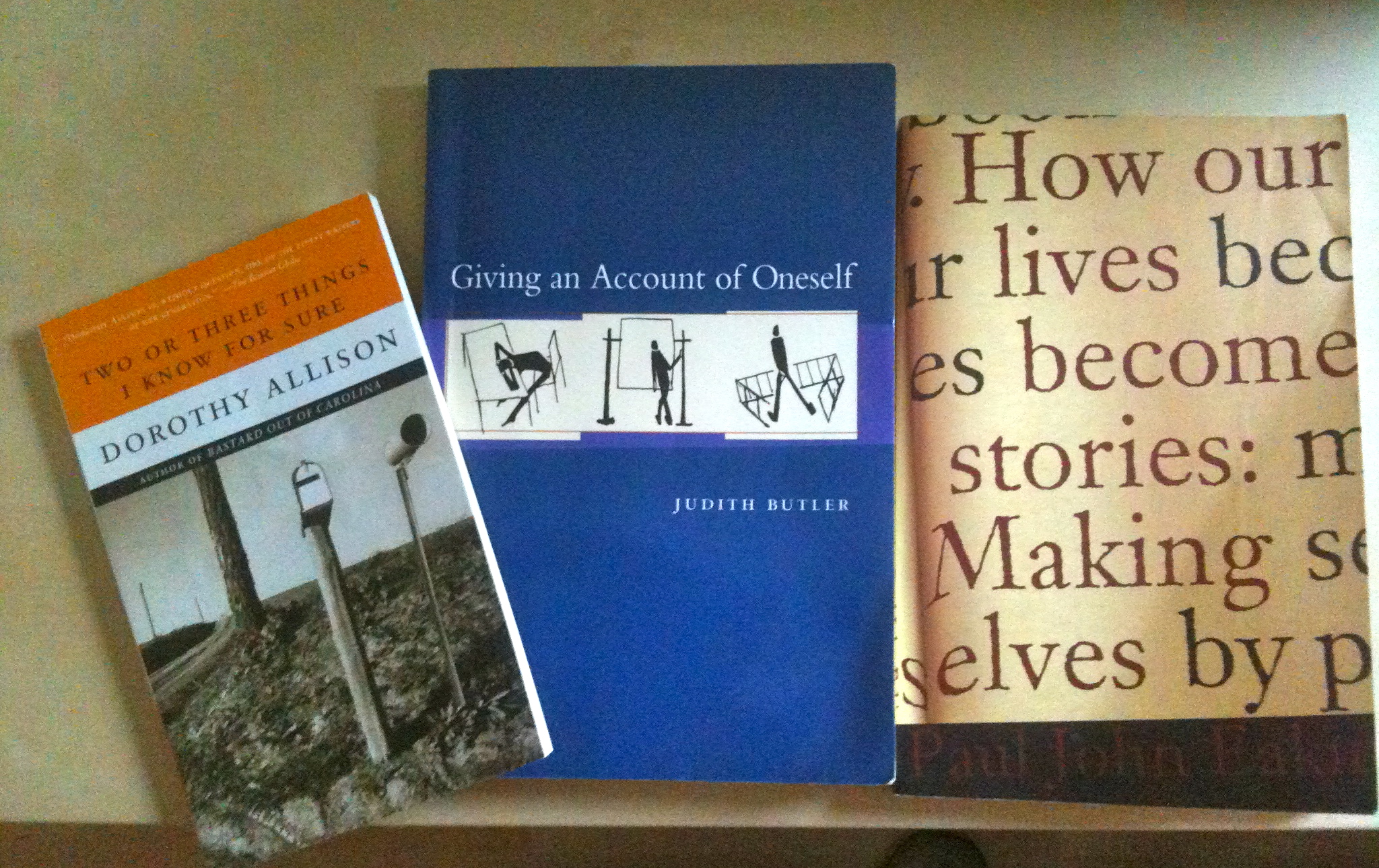
Tag: 200 words or less

Troubling Clowns

I want this book! I saw it today at the Wild Rumpus, an awesome kids’ bookstore not too far from my house. Okay, do I really want this book–I’m not sure, but it made me laugh (a lot) at the store. I could see it making a lot of trouble for kids and adults. It reminds me of this freaky art installation at the Art Institute of Chicago on clowns that I saw this past fall (AMP, can you remember this installation and the name of the artist who did it?).

SPOILER ALERT: Here’s the “pop-up” surprise in the middle of the book:

Now, there are lots of ways to connect clowns with troublemaking–excessive parody, playfulness, comedy, laughter. Maybe I should read more about clowns this summer…or, maybe not. I don’t need these clowns haunting my dreams!

Word count: 137 words

  • Del.icio.us
  • Digg
  • Facebook
  • Google Bookmark
  • StumbleUpon
  • Technorati

Did I mention that I love my iPad?

In a happy coincidence, my iPad arrived on the final day of my classes for the spring semester. Feeling adventurous, I decided to try grading some of my final papers on it, using Aji’s iAnnotate. This app enables you to get pdfs from your laptop, annotate them (with highlighting, underlining, post-it notes, free-writing mark-ups), and then upload them again. I read 5 of my student’s papers on my iPad and was able to highlight their text and make comments via annotated post-it notes. Then I uploaded them back to my computer and sent them as a attachments to the students. While I haven’t heard back from the students yet (I just sent them out last night and this afternoon), I found the experience to be very helpful. Actually, I love reading and grading papers this way. I think it will allow me to engage even more with the student and their writing/ideas. Once (and if) I hear back from students about their experiences getting feedback this way, I will write a follow-up post (or a comment on this post).

Here’s their description of what iAnnotate can do:

And here’s a brief example of my annotations on a document:

I don’t think I will ever read articles the same way again…

Word count: 200

  • Del.icio.us
  • Digg
  • Facebook
  • Google Bookmark
  • StumbleUpon
  • Technorati

My Spring Courses

Recently I have been working on my blogs for Feminist Debates and Feminist and Queer Explorations in Troublemaking. I currently have 50 students enrolled in my feminist debates course. Yet again I am pushing at the limits of how blogs can work in a classroom by requiring all of them to use our blog regularly. To make the process easier for everyone involved, I have spent a lot of time (maybe way too much) on the assignment and the worksheet that accompanies it.  I am looking forward to seeing how the blog works (or maybe doesn’t work) in such a big class. I wonder, do any instructors use blogs in really big classes–like classes with 75 students or more?

Word count: 116 words

  • Del.icio.us
  • Digg
  • Facebook
  • Google Bookmark
  • StumbleUpon
  • Technorati

The Blog Experiment: A Success!

If you are a regular reader of this blog, you know that I have been experimenting with blog assignments this past semester. While I made the blog a key part of both classes, I really emphasized it in my Queering Theory course. I made the blog/blog-related assignments worth 80% of their grade. The other 20% would be earned through participation/attendance in class.  I remember when I first thought about doing this in August, I was a little nervous. Would students be willing to do the blog? Contrary to popular belief, not all students are tech savvy nor do they embrace technologies like the blog, so I knew that there might be resistance. Well, having completed the semester, I am pleased to write that the blog assignment was a great success. Some of the students were (understandably) resistant, but they all did it–and they did it well. I am extremely proud of my students’ willingness to stretch themselves and to deeply engage with the readings and the ideas of the class. My goal is to write more about the experience in the upcoming weeks. For now, check out my fall 2009 blogs here and here.

Word count: 194 words

  • Del.icio.us
  • Digg
  • Facebook
  • Google Bookmark
  • StumbleUpon
  • Technorati

Thank you Mr. Mailman!

frames41hydl5cp2L._SS500_

Today I received two really cool books in the mail: Frames of War: When is Life Grievable? by Judith Butler (and here is her giving a lecture based on it) and Unbecoming Subjects: Judith Butler, Moral Philosophy, and Critical Responsibility by Annika Thiem. While I have been wanting to get Butler’s book for a couple of months now, I had not heard of Thiem’s book until the other day when I was looking on amazon for something else. Excellent. Yet another book that explores the ethical (and moral) implications of Butler’s work.

I must admit, I was a little disheartened after reading Thiem’s dis(mis)sing of virtue ethics in the beginning of the introduction (that’s how far I am right now). She writes:

Moral conduct cannot be reduced to what we owe others, to duties and obligations, and also not to VIRTUES, which can have equally restraining effects (1).

Oh well, I am still excited to read it and curious to find out how she links Butler’s ethical, political, and moral vision with critique and responsibility.

Oh, and as an aside: My wonderful neighborhood mailman retired today after 30 years. He really did give me a great parting gift!

Word Count: 196 words

  • Del.icio.us
  • Digg
  • Facebook
  • Google Bookmark
  • StumbleUpon
  • Technorati

Trouble as tonic?

Check out this “Briefly Noted” review of The Generalissimo by Jay Taylor in this week’s The New Yorker. Here’s the line that got me thinking:

Chiang [Kai-Shek] saw himself as central to China’s destiny, yet his years in exile were some of his happiest; as he once wrote, “Trouble is an excellent tonic.”

What exactly does he mean by trouble being a tonic here? It could mean that the trouble that Chiang experienced at the hands of Mao, that is the losing of mainland China and being exiled to Taipai, was not all bad. Chiang’s time in exile was productive and happy and may end up being more important for the success of modern China than Mao’s cultural revolution. What else might he mean? I wonder if this is a focus of the book or just the reviewer’s take on the book? I often find that The New Yorker book reviews are more interesting than the books that they review. I do like the idea of thinking about trouble as tonic as healing, restorative and invigorating. Cool.

Oh, did I happen to mention that I was obsessed with China and read way too many books about it in high school?

Word Count: 200 words

  • Del.icio.us
  • Digg
  • Facebook
  • Google Bookmark
  • StumbleUpon
  • Technorati

Little Miss Trouble, part II

When I first started watching this cartoon version of Little Miss Trouble, I thought it was going to be the same as the book. But a few subtle differences and a well placed comment on youtube make the cartoon worthy of its own entry.

I started to think more about this story when I saw the following comment about the cartoon on the youtube clip by Hoktak: “Haha, serve that little troublemaker right for being a gossipmonger! Mr. Small, Mr. Bump, and Mr.Tickle got her back good!”

Then it started to click. Here is another reason why I don’t like this story. Little Miss Trouble makes her trouble through gossip. Typically, gossip is understood to be something that is done by mean girls who like to spread nasty rumors. Gossip is also considered to be a particularly insidious and pointless activity that women-with-nothing-better-to-do engage in. It has no real or productive purpose other than to humiliate or anger the object of its talk. By using gossip as the way that Little Miss Trouble makes trouble, Hargreaves reinforces both the link between girls and gossip and the idea that girl(y) troublemaking is not real action but just mean, vicious talk.
Word count: 199 words
  • Del.icio.us
  • Digg
  • Facebook
  • Google Bookmark
  • StumbleUpon
  • Technorati

Experimenting with the Glossary of Terms

As I mention here, I am experimenting with different ways to do these entries. As I work on these terms, I ask myself: What are some effective ways to express what these terms mean? How can I (or my students) demonstrate an understanding and engagement with the term? What works best for me as reference points for future writings? How can I make these terms accessible to a wide and diverse audience without stripping them of their depth and complexity?

So far, I have used the following structures in my term entries:

Feistiness: informal structure; referenced and reflected on source where I encountered the term; posed questions and offered (somewhat) random thoughts on the term and what it meant for my larger project

Off-center: very formal structure with specific categories–definition, questions, applications, reflections, questions part 2, conclusions

Taking care = Staying in trouble: (inspired by AMP) provided dictionary definitions; very brief;  reflected on the significance of the definitions

I like all three (perhaps for different reasons). I will keep experimenting throughout the summer. Any thoughts on which one works better?

Word Count: 178 words

  • Del.icio.us
  • Digg
  • Facebook
  • Google Bookmark
  • StumbleUpon
  • Technorati

TAKING CARE = STAYING IN TROUBLE?

I happened to be looking up trouble on dictionary.com and found this connection between trouble and care:

CARE DEFINITIONS
3.
To take care, pains, trouble (to do something) implies watchful, conscientious effort to do something exactly right. To take care implies the performance of one particular detail: She took care to close the cover before striking the match. To take pains suggests a sustained carefulness, an effort to see that nothing is overlooked but that every small detail receives attention: to take pains with fine embroidery. To take trouble implies an effort that requires a considerable amount of activity and exertion: to take the trouble to make suitable arrangements.


1. concern, upset, confuse. 4. pester, plague, fret, torment, hector, harass, badger. 12. concern, grief, agitation, care, suffering. 14. See CARE 15. trial, tribulation, affliction, misfortune.

So, taking care = being vigilant/watchful = persistent (critical) attention = making an extra effort = not being complacent = staying in trouble.

I like this connection because it enables us to think about troublemaking as something other than disruptive and destructive; it is a form of care. For me, this connection is key for thinking about the ethical implications and import of making/being in/staying in trouble.

Word Count: 193 words

  • Del.icio.us
  • Digg
  • Facebook
  • Google Bookmark
  • StumbleUpon
  • Technorati

Troublemaking in 200 words or less…

So, I use blogs a lot in the courses that I teach and I am always experimenting with how to use them better. I think getting students to participate through the blog is an excellent way to help them organize their thoughts and articulate them in succinct (and hopefully coherent) ways to their fellow students. This past semester I required that my students submit weekly 200 word entries. They grumbled a little about the word length as being too short. I told them that they should be able to express their main idea in a sentence or two. If you can’t express it simply and succinctly, I would always say, then you don’t really understand it.

But, how hard is it really to write short, succinct entries that get at the main point of an article or that do an effective job of conveying your thoughts? Am I able to do that?  I have decided to try an experiment with 200 word entries to see how effective I am at completing my own assignments. I hope to create a bunch of these and mix them in throughout the summer. This was my first attempt and it was hard. It is 200 words exactly.

  • Del.icio.us
  • Digg
  • Facebook
  • Google Bookmark
  • StumbleUpon
  • Technorati